[ Update: May 17, 2023— I thought of a way for the lid on the bike box to be even more simple while still hinging on the front roof, so I will be re-making my box to be in that style, as in the following sketch:
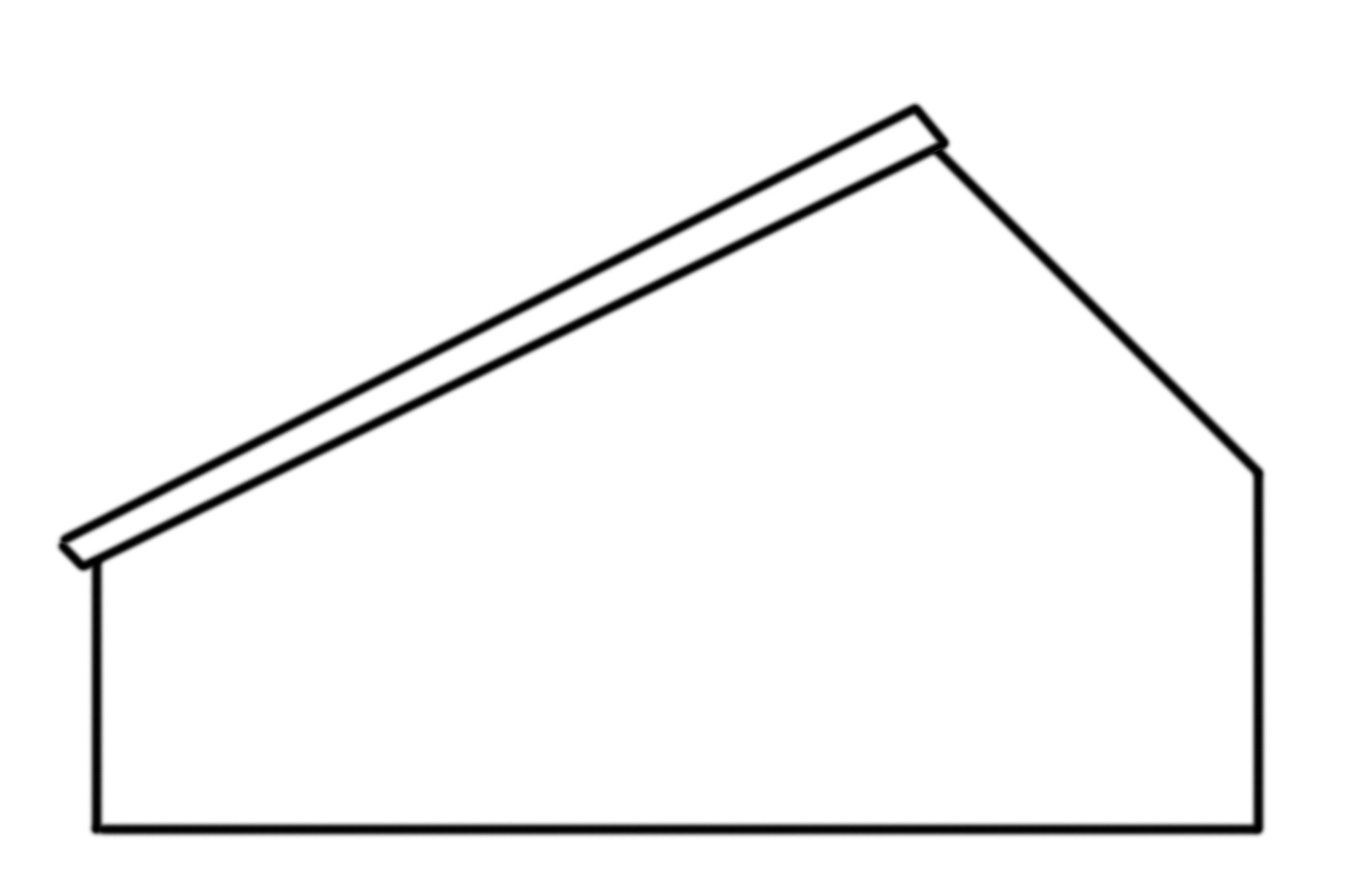
I think the original removable panel design would have been ok, but I should have focused a bit more on making the panels as small as possible. ]
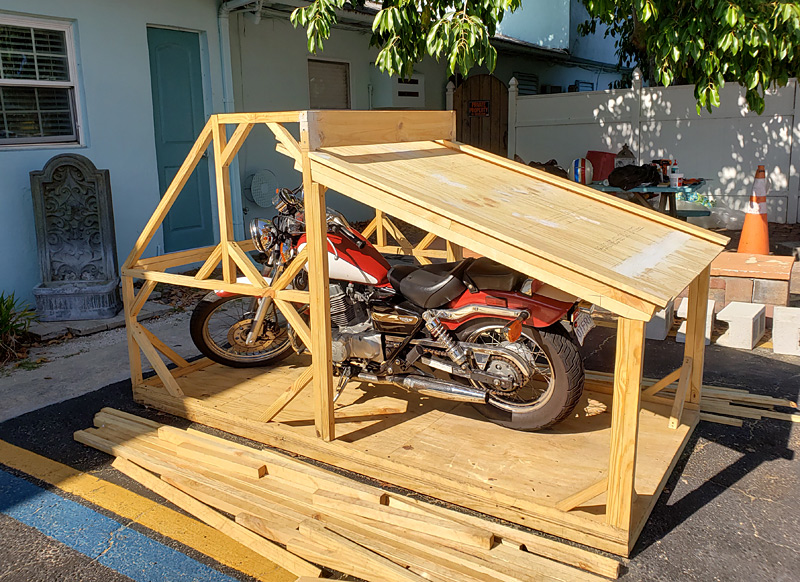
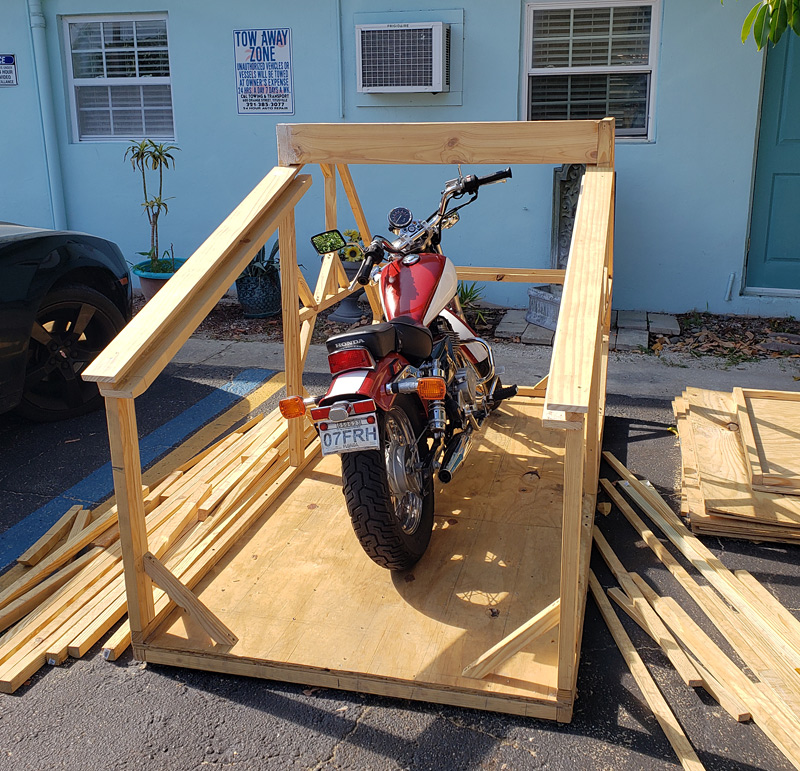
I’ve been building a weatherproof shed for my motorcycle. It’s coming along well, but it has been taking longer than I thought it would.
I think the biggest mistake that I made was not designing it first using CAD, but rather I designed it only on paper. I promised myself during my last project that I would never do another project without designing it first in CAD, however my current computer is rather old and not compatible with the latest version of Sketchup, so I would have had to go through the extra expense of buying and configuring a newer computer and then also paying for the Google Sketchup software.
But now I’m tempted to buy a cheap Windows PC and get Sketchup for that, and then recreate the design of the box using that after the fact, actually. I’m sick of not being set up for designing things in CAD, and I want to make sure it won’t happen again.
The idea of the box was to make it as compact as possible, where I used a concept of water-tight removable panels, as shown in the above pictures. (I also still need to add some extra reinforcement gussets to parts of the design, I will post updates over the next few days as it is coming along.)
After spending some time working though it I’m confident that the panels are going to be very water-tight.
___
The other day someone suggested putting the main large panel on a hinge so it can be lifted upwards rather than needing to be removed, which I think is a very good idea; although I think the box would need to be less compact in order to accommodate that without having leakage problems, as I have illustrated in the following picture which is a theoretical side view of such a box:
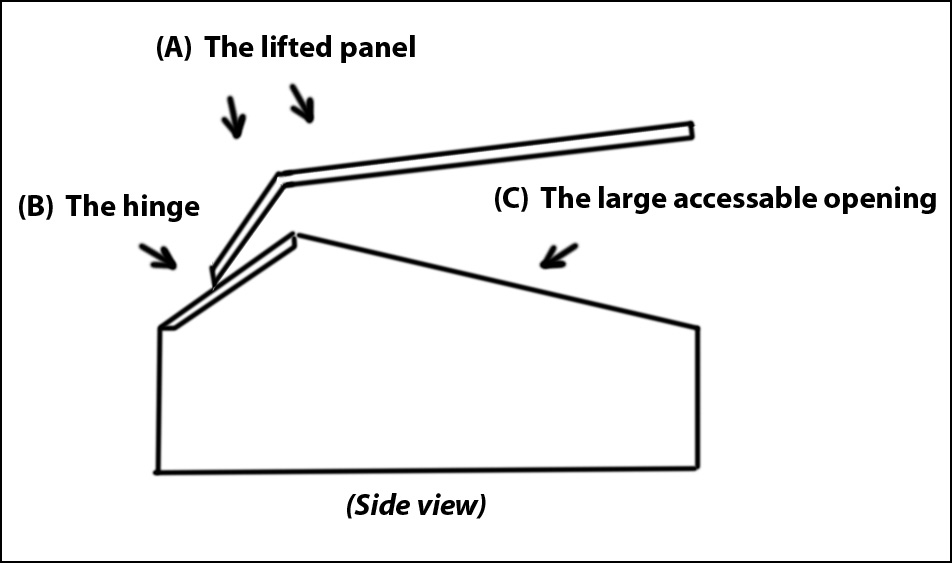
(A) The LIFTED PANEL that always has an angle in it so it will mold to the shape of the point in the roof when the panel is closed— where it will ensure that no water will get inside the large opening when the panel is closed.
(B) The location for the HINGE(S) which should be attached halfway down the front slanting roof, where any water running through the hinges will simply run the rest of the way down the front roof without getting inside anywhere.
(C) The LARGE ACCESSIBLE OPENING that will exist when the panel is lifted.
If I were to put the main panel on a hinge, I would want to make sure that the hinge would naturally not let any water into the box, such as in the above picture. So I think it is really too late to employ such a hinge on the current design that I’m building; but I don’t think that it will really be a problem since I’m confident that the removable panels will not really be an inconvenience to deal with. One benefit of the removable panels is that they allow the box to be more compact than it would have needed to be if it had a hinge. Actually I could have made the panel a bit smaller even but I think it is too late to worry about that now, it will be fine.
Another reason that I want to get CAD running is so I can at least make a real working design of an alternate version of the box that uses hinged panels as in the above rough sketch. I can get away with using removable panels with a box for my motorcycle because it is a small bike, but for larger motorcycles I think such removable panels would be too large and heavy to be practical to deal with.